3D exterior house rendering is the technology-driven process of generating photorealistic, computer-simulated images of a residential building’s outer facade, site context, landscaping, and atmospheric environment – all before a single construction decision is finalized. It uses physically based rendering (PBR) engines, parametric 3D geometry, high-dynamic-range (HDRI) lighting, and procedural texturing to produce visuals that are indistinguishable from real photography. As a critical architectural visualization tool, it eliminates design ambiguity by transforming 2D blueprints and CAD drawings into fully navigable, decision-grade imagery for homeowners, architects, and builders alike.
Planning a new build, a major renovation, or even a curb appeal upgrade? One of the biggest frustrations homeowners face is not being able to picture the final result. Architectural drawings are hard to read, material samples look different at scale, and verbal descriptions leave too much to the imagination. That is exactly where 3D exterior house rendering changes everything.
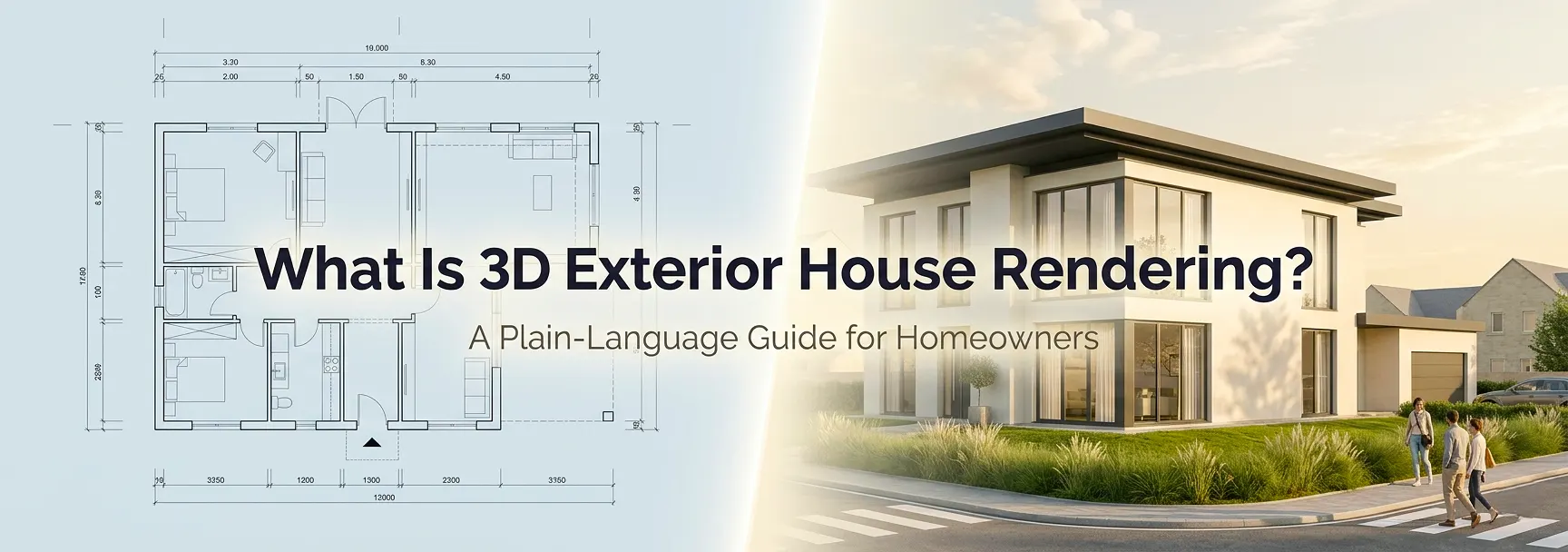
This guide breaks down what 3D exterior house rendering actually is, how the process works, what it costs, and why it is quickly becoming a standard step in modern home design – not just a luxury for developers.
What is 3D Exterior House Rendering, Exactly?
At its simplest, 3D exterior house rendering is the creation of photorealistic digital images of what your home will look like from the outside – before construction begins or before a renovation contractor lifts a single tool.
A professional rendering artist (or team) builds a detailed digital model of your home using specialized 3D software. They then apply:
- Realistic materials: brick, stucco, wood cladding, stone veneer, glass, metal roofing
- Accurate lighting: sun angle, time of day, shadows, reflections
- Contextual surroundings: lawn, trees, driveway, neighboring structures, sky
- Color schemes and finishes: exactly the palette you are considering
The result is an image – or a series of images from multiple angles – that looks like a professional photograph of a home that does not yet exist.
According to Chaos, developers of V-Ray rendering software, physically based lighting systems and HDRI maps are the backbone of achieving this photorealistic quality in modern exterior renders.
How Does 3D Exterior Rendering Work? (Step-by-Step)
Understanding the workflow helps you collaborate more effectively with your rendering team and get results that truly match your vision.
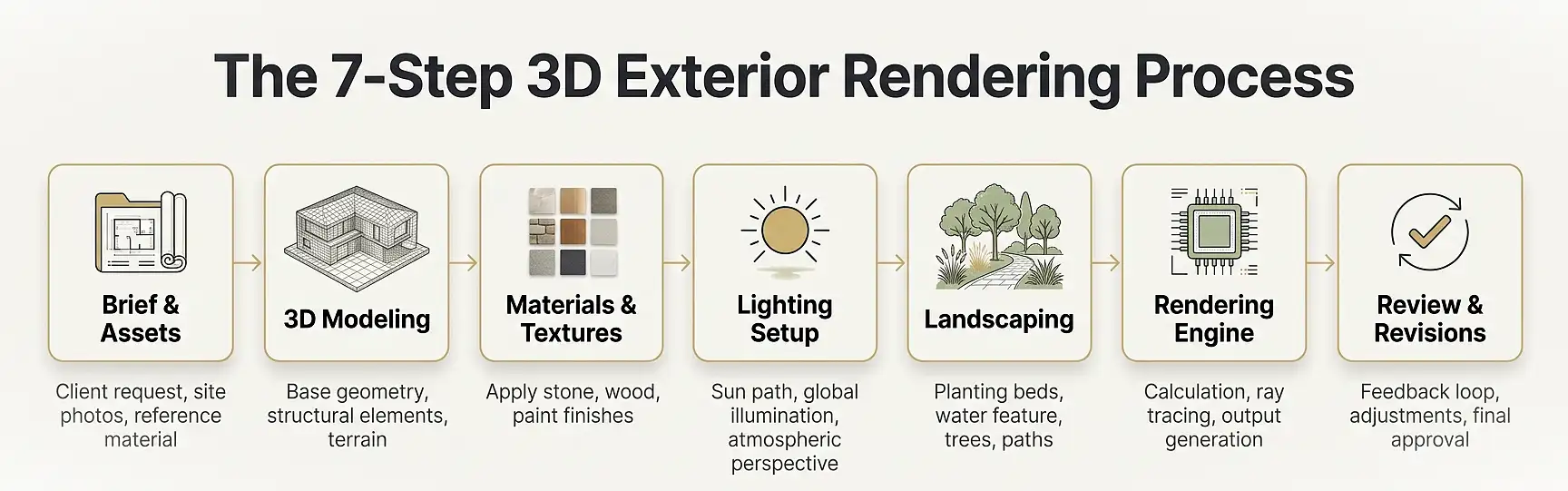
Step 1: Brief and Asset Collection
You share your architectural drawings, CAD files, sketches, material selections, and any photo references that capture your preferred style. The more detail you provide at this stage, the more accurate your render will be.
Step 2: 3D Model Construction
The rendering artist builds a precise digital model of your home – walls, roofline, windows, doors, and all exterior features – to exact dimensions. Nothing is estimated or freehand.
Step 3: Material and Texture Application
Every surface receives its real-world material. A brick finish gets its mortar joints. Wood siding shows grain. Glass windows reflect the sky. This layer of detail is what separates a great render from a generic one.
Step 4: Lighting Setup
Virtual sun and sky systems simulate the actual light conditions you want – a golden late-afternoon glow, an overcast midday, or a dramatic twilight scene. Shadows fall at precise angles relative to your building’s orientation and geographic location.
Step 5: Environment and Landscaping
Trees, shrubs, pathways, cars, and neighboring context are added to make the scene feel grounded in reality rather than floating in a digital void.
Step 6: Rendering and Post-Production
The scene is processed through a rendering engine (such as V-Ray, Corona, or Lumion), which calculates how light interacts with every surface. Minor color grading and sharpening are applied in post-production to finalize the image.
Step 7: Review and Revisions
You review the result, request any changes – swap the roof color, widen the driveway, change the window frames – and the team delivers revised versions until the image matches your vision exactly.
Why Homeowners Are Investing in 3D Exterior Visualization
1. See It Before You Build It
The most obvious benefit is also the most powerful: you know exactly what you are getting. No surprises after the concrete is poured or the cladding is installed.
2. Confident Design Decisions
Choosing between two facade materials, two window styles, or two landscaping approaches is much easier when you can see both options rendered at full scale. A render turns a subjective debate into a visual comparison.
3. Fewer Costly Change Orders
Changes during construction are expensive. A single exterior rendering session that resolves a design disagreement upfront can save many times its cost in avoided rework. As industry research from Archicgi confirms, 3D visualization for renovations and new builds directly reduces the number of on-site revisions.
4. Smoother Approvals and Permits
Many local planning authorities and HOA review boards now prefer or require photorealistic visualizations for approval submissions. A high-quality render can speed up the approval process significantly.
5. Powerful Communication Tool
Renderings bridge the gap between what you imagine and what your architect, builder, or contractor actually understands. They become the single source of visual truth for everyone on the project.
6. Real Estate and Resale Value
If you are building a custom home or making a major exterior upgrade, professional 3D rendered images can also be used in real estate listings – often achieving faster sales and stronger buyer interest.
Types of 3D Exterior House Renderings
Not every rendering project is the same. Depending on your goals, you might need one or more of the following types:
| Rendering Type | Best For | Output Format |
|---|---|---|
| Still Exterior Image | Single-view visualization, permit submissions | High-resolution JPEG or PNG |
| Multi-Angle Package | Full design review, HOA approval, marketing | 3-6 images from different viewpoints |
| 360-Degree Panorama | Immersive review, real estate presentations | Interactive panoramic file |
| Aerial / Bird’s-Eye View | Site planning, large lot context | Top-down or angled overhead image |
| Walkthrough Animation | Real estate marketing, investor presentations | MP4 video file |
| Twilight / Dusk Render | Mood-based marketing, luxury properties | High-contrast atmospheric image |
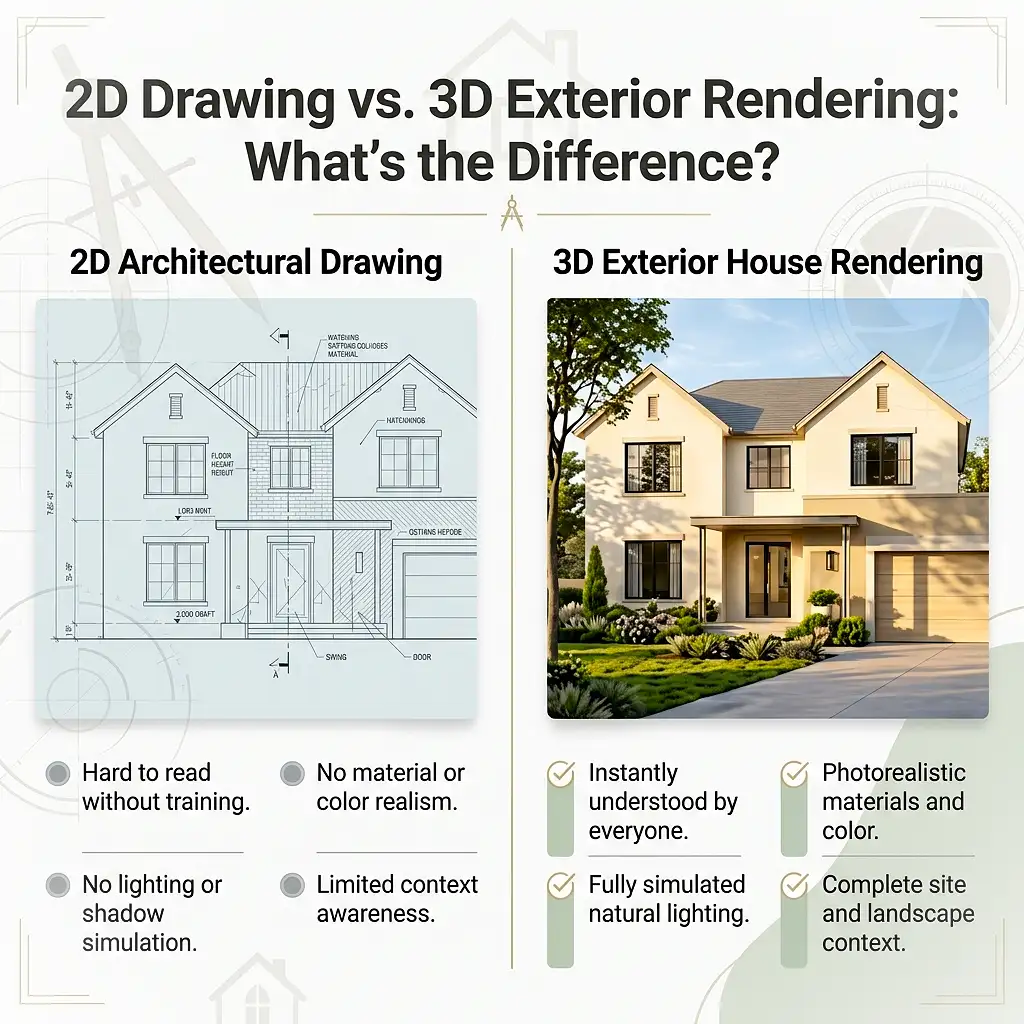
3D Exterior Rendering vs. Traditional 2D Drawings: A Comparison
| Feature | 2D Architectural Drawing | 3D Exterior Rendering |
|---|---|---|
| Readability for homeowners | Difficult without training | Immediately intuitive |
| Material and color accuracy | Symbolic, not realistic | Photorealistic |
| Lighting representation | None | Fully simulated |
| Landscaping context | Limited or absent | Fully integrated |
| Revision flexibility | Time-consuming | Fast digital edits |
| Approval communication | Technical, limited impact | Visually persuasive |
| Cost of changes after review | High (construction stage) | Very low (digital stage) |
What Does 3D Exterior House Rendering Cost?
Pricing varies depending on the complexity of the project, the number of views, and the quality tier of the studio you work with.
Based on current 2026 market data from Render3DQuick’s pricing guide:
- Entry-level exterior render: $249 – $499 per image
- Mid-tier professional exterior render: $500 – $1,500 per image
- High-end architectural visualization studio: $700 – $2,500+ per image
- 360-degree panorama: $800 – $2,000
- Walkthrough animation: $2,000 – $12,000+ per minute
For most residential homeowners working on a new build or major renovation, a package of 3-5 still images from a professional studio typically falls in the $1,500 – $5,000 range.
The key insight: one round of exterior changes avoided on-site will almost always cost more than the rendering investment. It is design insurance, not just a visual asset.
Common Mistakes Homeowners Make with 3D Exterior Rendering
Knowing what to avoid will save you time, money, and frustration.
Mistake 1: Providing Vague or Incomplete Briefs
The rendering is only as accurate as the information you provide. Sketchy instructions produce generic results. Share detailed drawings, exact material specifications, and photo references for every element you care about.
Mistake 2: Choosing Based on Price Alone
An extremely cheap render often reflects generic templates, stock landscapes, and limited revision rounds. When you are making decisions that affect a $500,000 build, saving $200 on a render is rarely the right trade.
Mistake 3: Reviewing Only One Angle
Approving a design based on a single front-elevation image can hide problems on the side or rear of the property. Always request at least two to three angles for meaningful design review.
Mistake 4: Treating It as the Final Step
Many homeowners request a render after all design decisions are locked in, then discover issues they wish they had caught earlier. The ideal time to commission a render is before finalization, not after.
Mistake 5: Ignoring Landscape and Context
A render showing the home in isolation – without trees, driveway, lawn, or neighborhood context – gives a false sense of the final result. Always request environmental context in your rendering brief.
Expert Tips for Getting the Most from Your 3D Exterior House Rendering
- Start early. Commission your rendering during the design development phase, not after construction documents are issued.
- Provide photo references. A mood board of homes you love communicates style intent far more clearly than written descriptions.
- Request multiple lighting scenarios. Daytime, dusk, and overcast renders reveal different aspects of the same design.
- Iterate digitally. Use the rendering revision process to test two or three facade options side by side before making final material commitments.
- Match the rendering camera to real site angles. Ask your studio to simulate the actual street-level view angle from your primary viewpoint – this makes the render more useful as a communication tool.
- Work with specialists. General graphic designers are not the same as architectural rendering specialists. Always review a studio’s portfolio of residential exterior projects before hiring.
Working with a dedicated 3D exterior house rendering company that focuses exclusively on residential visualization ensures you get technically accurate, architecturally credible results – not generic digital artwork.
Who Uses 3D Exterior House Rendering?
While architects and real estate developers have used rendering for years, the following groups are increasingly commissioning it for residential projects:
- Custom home builders and their clients: to align on design before groundbreaking
- Homeowners planning additions or second stories: to visualize how the addition integrates with the existing structure
- Renovation contractors: to present proposed exterior updates – new siding, windows, roofing, or porches – to clients
- Real estate agents listing new builds: to market homes before completion
- HOA applicants: to gain committee approval for exterior modifications
- Landscape architects: to show how planting, hardscape, and structure work together
Frequently Asked Questions About 3D Exterior House Rendering
What is 3D exterior house rendering in simple terms?
3D exterior house rendering is the process of creating a photorealistic digital image of what your home will look like from the outside – before it is built or renovated. It uses 3D modeling software to simulate materials, lighting, landscaping, and the surrounding environment with photograph-level realism.
How long does a 3D exterior house rendering take?
Most professional studios deliver a residential exterior rendering within 5-10 business days. Complex projects, animation, or multiple views may take 2-3 weeks. Rush delivery is often available at an additional cost.
Do I need architectural drawings to get a 3D exterior rendering?
Having drawings, CAD files, or even detailed sketches significantly improves accuracy. However, many studios can work from photographs of an existing home combined with written specifications if formal drawings are not available.
What is the difference between 3D rendering and a floor plan?
A floor plan is a 2D top-down technical drawing that shows room layout and dimensions. A 3D exterior rendering is a realistic visual representation of how the building looks from the outside. They serve very different purposes: floor plans guide construction; renderings guide design decisions and communication.
Can a 3D exterior rendering show different material options?
Yes – and this is one of its greatest practical benefits. A rendering artist can produce multiple versions of the same view, each showing a different facade material, color, or window style, allowing you to make direct visual comparisons before committing.
Is what is 3D exterior house rendering only for new builds?
Not at all. Renovation, remodeling, and exterior upgrade projects – new siding, roof replacement, porch addition, window replacement, landscaping redesign – all benefit from exterior rendering. Seeing the proposed changes on a render of your actual home removes all guesswork.
How accurate is a 3D exterior rendering compared to the finished result?
When built from accurate drawings and detailed material specifications, a professional 3D exterior house rendering is highly accurate. The key variable is the quality of the inputs: precise measurements and exact material data produce near-identical results.
See Your Home Clearly Before You Build It
3D exterior house rendering has shifted from a specialist tool used only by large development firms to an accessible, practical resource for homeowners at every scale. Whether you are building a custom home from scratch, adding a second story, reclading the facade, or simply comparing two roof colors, a professional exterior render gives you a level of visual certainty that no drawing, mood board, or material sample can match.
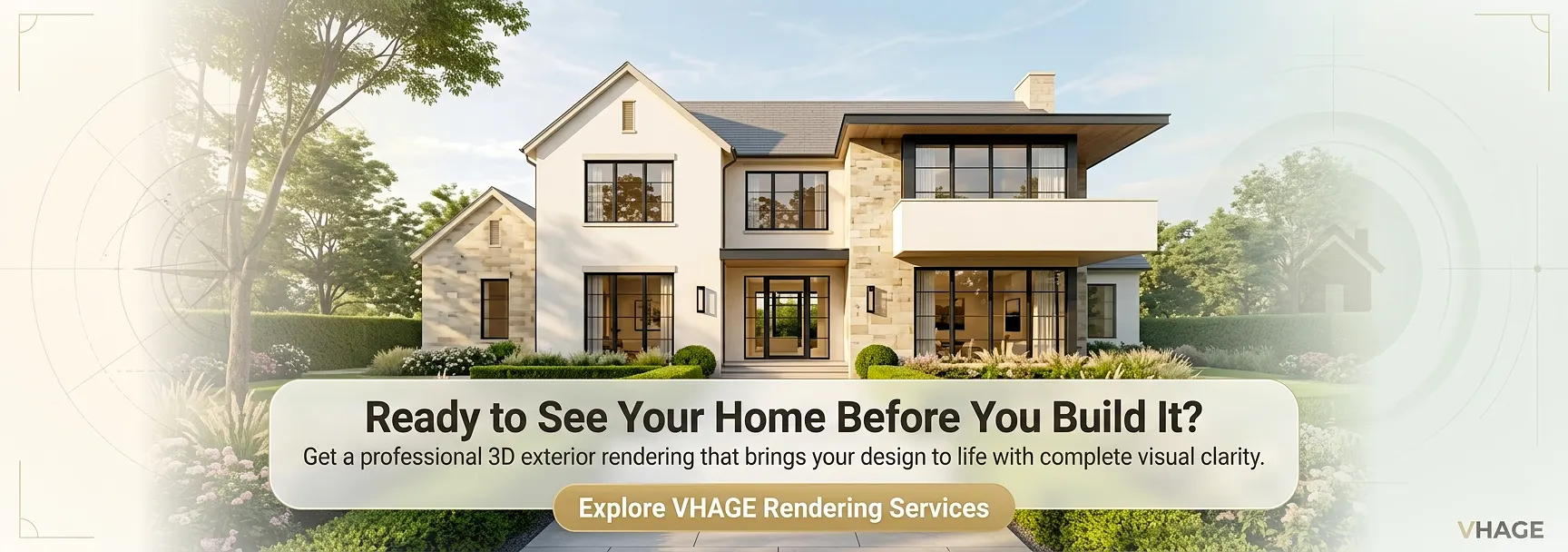
The investment is modest relative to the cost of a construction mistake or an unplanned design change. More importantly, it puts you in control: you make informed, confident decisions based on what you can actually see, not what you hope the end result will look like.
If you are ready to see your project with complete visual clarity – before a single brick is laid – explore professional 3D exterior house rendering services from VHAGE and bring your design vision to life with precision and confidence.