
3D exterior rendering for real estate marketing is a photorealistic pre-construction visualization methodology that converts architectural drawings and site plans into buyer-facing, high-fidelity CGI imagery – enabling agents to list, promote, and sell residential and mixed-use properties before a foundation has been poured. By deploying physically based rendering pipelines, sun-accurate lighting models, and fully staged digital environments, real estate professionals generate MLS-ready imagery, digital advertising assets, and buyer presentation materials from approved construction documents alone. The result is a complete pre-sales and marketing collateral ecosystem that compresses the buyer decision cycle, supports off-plan contract execution, and eliminates the market entry delay traditionally caused by the wait for physical construction completion.
The real estate industry has always rewarded those who move fastest. Yet for decades, agents marketing new construction and pre-build residential properties faced an unavoidable bottleneck: you could not show buyers a home that did not yet exist. That constraint no longer holds.
Why 3D Exterior Rendering for Real Estate Marketing Is Reshaping Pre-Sales
The pre-construction sales window is the most commercially critical phase of any residential development. It is also the period when marketing assets are hardest to produce – because there is nothing physical to photograph.
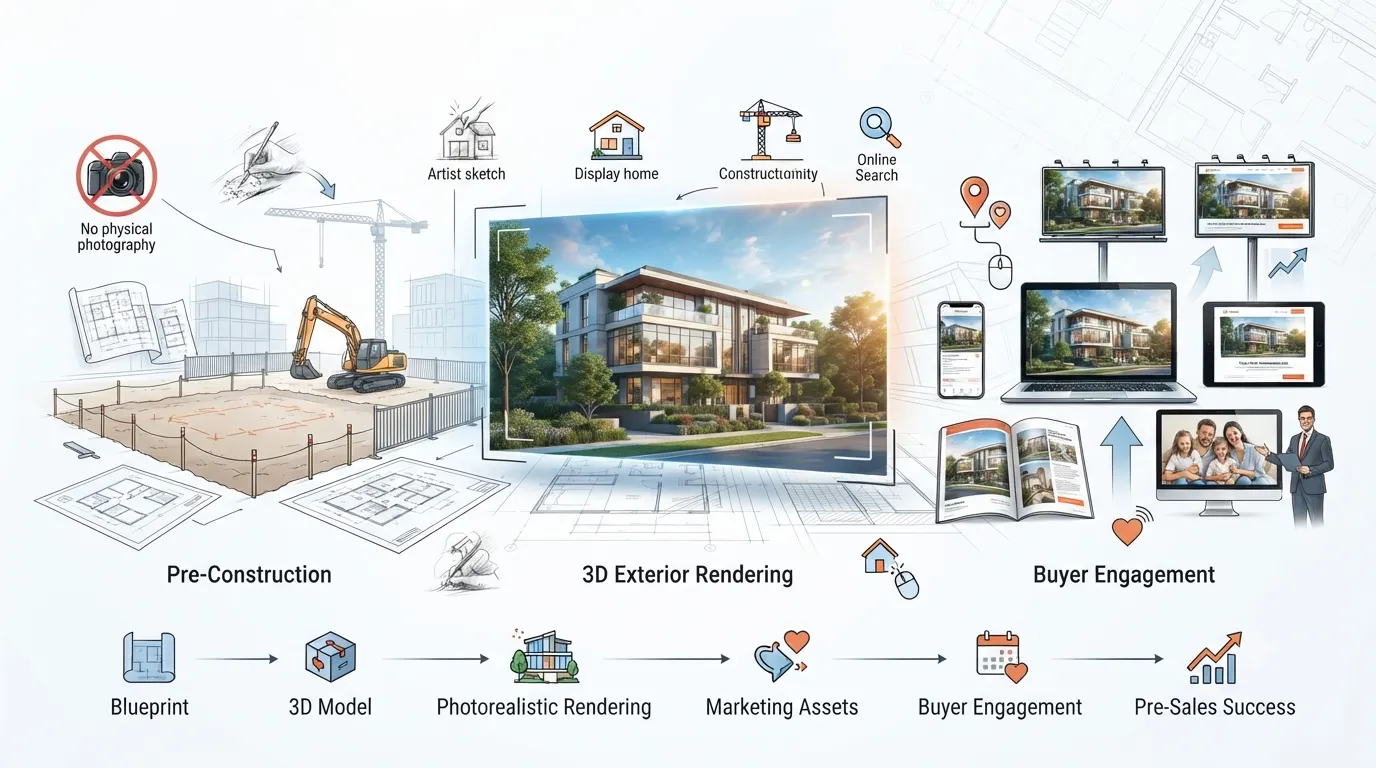
Traditional workarounds have included:
- Printed artist impressions that look dated and unconvincing to modern buyers
- Show homes or display suites that require significant build investment
- Site hoardings with rough sketches that generate minimal buyer confidence
- Waiting until construction progresses before launching marketing campaigns
Each of these approaches sacrifices either speed, budget, or buyer trust. 3D exterior rendering for real estate marketing eliminates the trade-off entirely.
According to the National Association of Realtors (NAR), over 95% of buyers use online resources during their home search. Listings supported by high-quality photorealistic imagery generate significantly more inquiries, more saved listings, and more appointment requests than those relying on drawings or vacant lot photography. The quality of the visual asset is directly correlated with buyer engagement.
For a foundational understanding of how the rendering process works from a technical standpoint, the complete guide on how 3D exterior house visualization is produced explains the methodology in detail.
What Real Estate Agents Gain From Pre-Construction 3D Exterior Visualization
3D exterior rendering gives real estate agents a complete, professional-grade marketing toolkit before construction begins. Specifically, agents gain:
Photorealistic listing imagery: High-resolution still renders produced from multiple camera angles, formatted for MLS listings, property portals, and printed marketing materials.
Digital advertising assets: Rendering outputs sized and formatted for Google Display, Facebook and Instagram ads, LinkedIn campaigns, and YouTube pre-roll video thumbnails.
Off-plan buyer presentations: A comprehensive visual package that allows buyers to evaluate a home’s exterior character, material palette, landscaping, and site context during in-person or virtual sales consultations.
Developer and builder marketing collateral: Brochures, landing page hero images, site signage, and project launch event materials – all produced from rendering outputs before a single sod is turned.
HOA and planning visualization support: Photorealistic renderings of approved designs used in community association presentations and local planning communications.
Agents who invest in professional photorealistic exterior rendering and visualization services at the point of listing commission consistently report higher inquiry volumes, shorter time-to-contract, and stronger buyer confidence during the offer stage.
How Real Estate Agents Use 3D Exterior Rendering: A Step-by-Step Marketing Workflow

Step 1 – Source Approved Architectural Drawings From the Builder or Developer
The rendering process begins with accurate source documents. Real estate agents working with builders or developers should request:
- All four building elevation drawings (front, rear, left side, right side)
- The site plan showing the home’s position, orientation, driveway, and lot boundaries
- Material and finish specifications (siding type, roof material, window frame color, door style)
- Landscape plan (if available) or a general brief describing proposed planting and hardscape
- Any HOA-approved color palette documentation
Complete and finalized drawings produce the most accurate and commercially credible renderings. Where drawings are still at a preliminary
Step 2 – Brief the Rendering Studio With Marketing Context
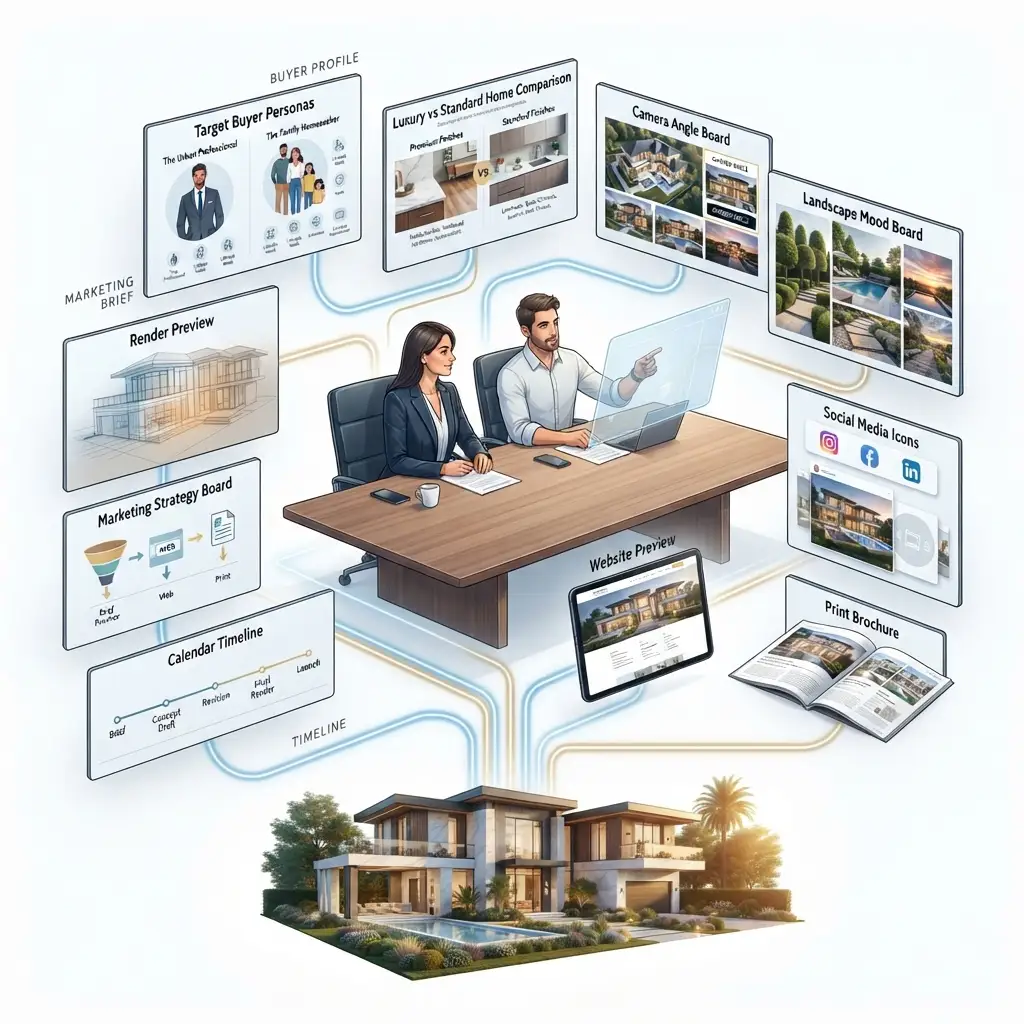
Unlike architectural rendering commissioned purely for design review, real estate marketing rendering requires an additional layer of brief information that is specifically commercial in nature. A strong marketing rendering brief should include:
- Target buyer profile: The demographic and lifestyle aspirations of the intended purchaser directly influence staging choices, landscape maturity, and time-of-day lighting selection.
- Listing price tier: A premium luxury listing warrants a different visual treatment from a first-home-buyer product. The rendering must signal the correct value position immediately.
3. Key selling features to foreground: If the home’s defining attributes are its street presence, a specific architectural feature, or an expansive driveway, these must be prioritized in camera angle selection.
4. Planned advertising placements: MLS listing images, social media ads, and print brochures each have different aspect ratio and resolution requirements. Brief the studio on all intended output formats at the start.
5. Timeline to listing or project launch: Pre-construction marketing campaigns benefit most from renderings that are ready before the official launch date. Build the rendering timeline into the overall marketing plan.
Step 3 – Select Camera Angles for Maximum Marketing Impact
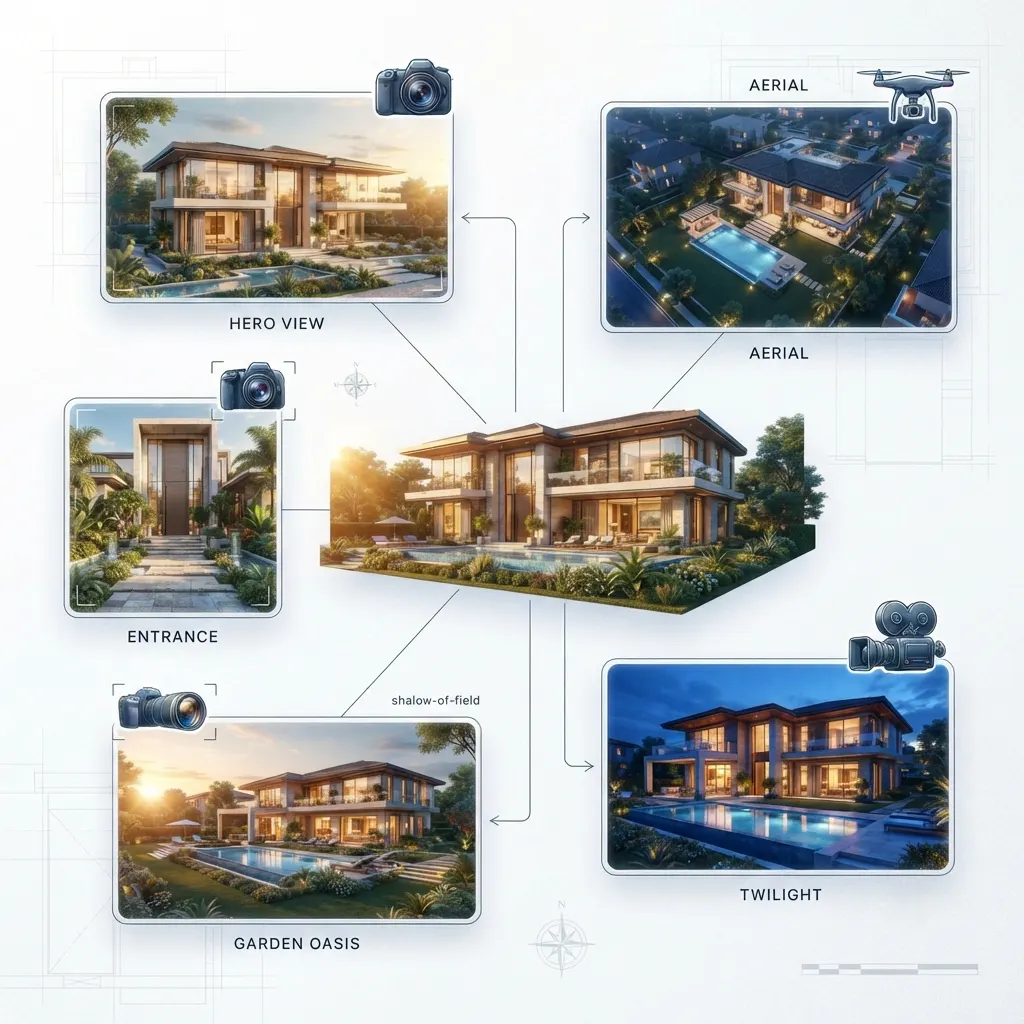
Camera angle selection in real estate marketing rendering is a strategic decision, not simply a technical one. The angles chosen determine how buyers first experience the property and which features are immediately legible.
For a standard residential property, agents should request:
- Primary street-level hero angle: The home viewed from the natural approach line – typically from the street at a slight 3/4 angle that captures both the principal facade and one side elevation. This is the listing image.
- Entrance and driveway approach: A perspective that draws the eye from the street toward the front door, emphasizing arrival experience and curb appeal.
- Rear or garden elevation: Essential for homes with outdoor living features: pools, decks, alfresco areas, or rear-facing living rooms with large windows.
- Aerial or elevated perspective: Particularly valuable for corner lots, elevated sites, or homes where the roof form and landscaping are architectural selling points.
- Dusk or twilight rendering: One of the most commercially powerful outputs in real estate marketing. Warm interior lighting glowing through large windows against a peach-and-lavender evening sky creates an emotional resonance that daytime images cannot replicate.
Step 4 – Integrate Landscape and Lifestyle Staging
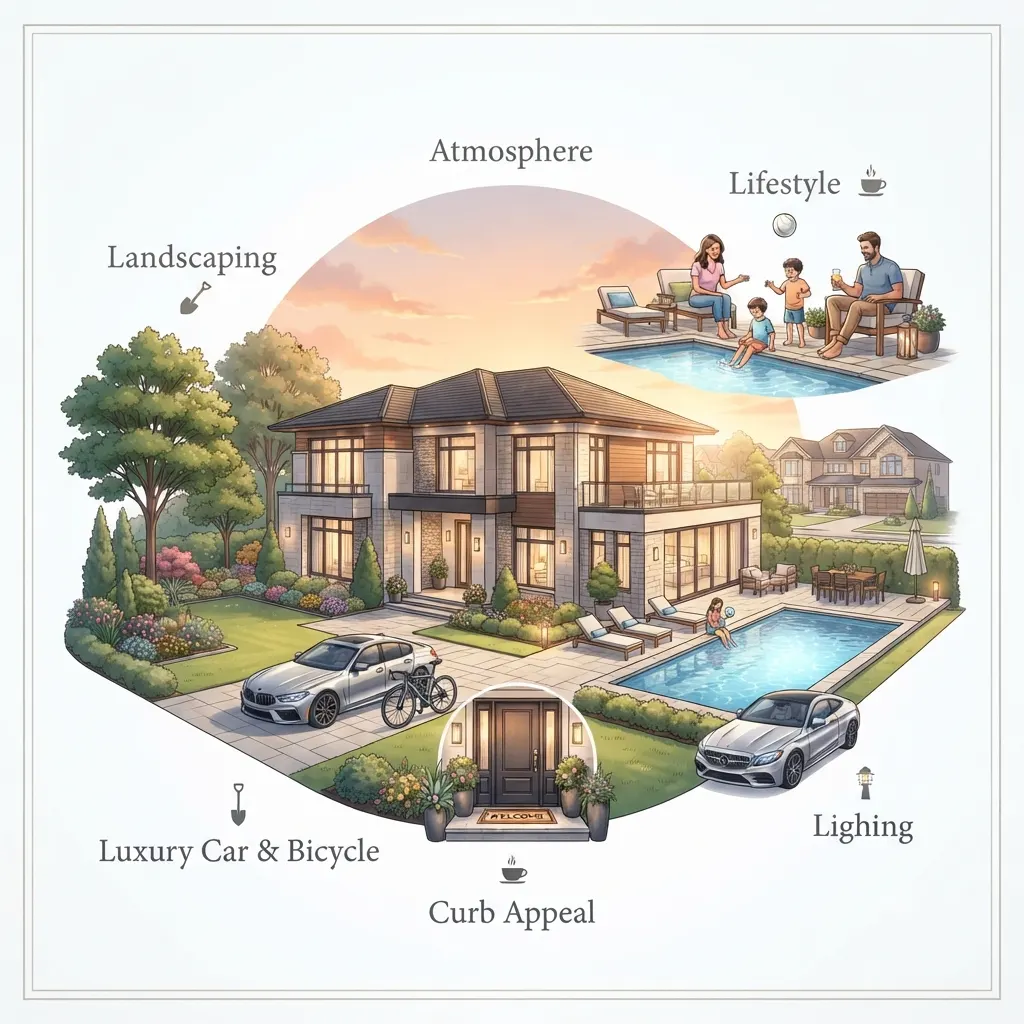
Photorealistic exterior rendering for real estate marketing goes well beyond the building itself. The staging of the surrounding environment is equally important for buyer emotional connection.
Professional staging elements include:
- Mature, aspirational landscaping: Not sparse plantings or bare earth, but a fully realized garden with ornamental trees, structured hedging, lush lawns, and seasonal flowering plants
- Lifestyle props: A luxury car in the driveway, a bicycle by the front door, ambient details like a lit lantern or a welcome mat – all calibrated to the target buyer profile
- Sky and atmospheric conditions: A warm blue-sky day reads as welcoming and optimistic. A golden-hour rendering suggests warmth and lifestyle. Both are strategic choices based on the emotional tone the listing should project
- Neighborhood context: Where surrounding homes, street trees, and road surfaces are available in the site plan data, including them increases the realism and credibility of the rendering for buyer trust
Step 5 – Format and Deploy Across Marketing Channels
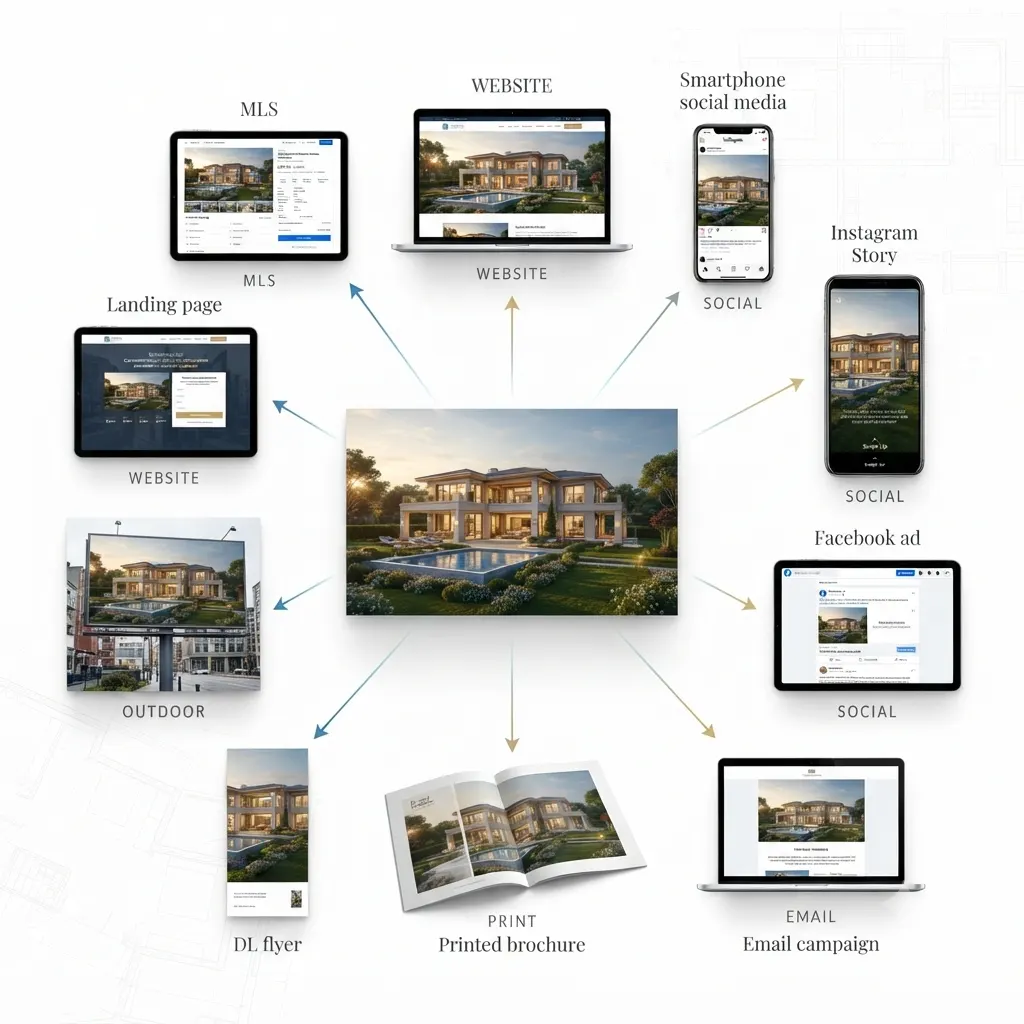
With rendering assets delivered, the real estate agent moves into the multi-channel deployment phase. Effective distribution of 3D exterior rendering outputs includes:
MLS and Property Portals: Upload the primary hero render as the lead listing image. Use additional angles as gallery images. Ensure file resolution meets portal minimum specifications (typically 1,024 x 768 pixels minimum; 3,000 x 2,000 pixels recommended for high-quality display).
Social Media Advertising: Crop and resize renders for Facebook/Instagram feed ads (1:1 square), Stories ads (9:16 vertical), and LinkedIn image posts (1.91:1 landscape). Use the dusk rendering for emotional retargeting campaigns, and the daytime hero image for awareness-stage traffic campaigns.
Email Marketing to Buyer Databases: A pre-construction listing email featuring a photorealistic exterior render generates dramatically higher click-through rates than a text-and-floorplan email. Use the rendering as the email hero image with a clear CTA link to the listing or project landing page.
Printed Brochures and DL Flyers: High-resolution rendering outputs (300 DPI minimum) are production-ready for print without additional post-processing. Use the primary hero angle on the cover and additional angles inside the brochure alongside floorplans and specification details.
Project Landing Pages and Microsites: New construction projects benefit significantly from dedicated landing pages built around rendering imagery. A photorealistic hero banner, a gallery of multiple angles, and a dusk or twilight feature image provide a complete visual narrative that drives inquiry form completions.
The Commercial Impact of 3D Rendering on Real Estate Sales Performance
| Marketing Scenario | Without 3D Rendering | With 3D Exterior Rendering |
|---|---|---|
| Pre-construction listing quality | Vacant lot photos or rough sketches | Photorealistic, MLS-ready imagery |
| Time to first buyer inquiry | Delayed until construction progress | Immediate on listing launch |
| Off-plan contract execution | Difficult – buyers lack visual confidence | Significantly more achievable |
| Social media ad click-through rate | Low – non-visual listings underperform | High – photorealistic imagery outperforms |
| Buyer emotional connection at first viewing | Minimal | Strong – aspirational imagery drives connection |
| Marketing collateral production timeline | Dependent on construction completion | Available from approved drawings alone |
| Competitive positioning vs. other listings | Weak before construction begins | Strong from day one of the marketing campaign |
Comparing Real Estate Marketing Asset Types for Pre-Construction Properties
| Asset Type | Visual Realism | Buyer Trust Level | Production Cost | Speed to Market | Revisability |
|---|---|---|---|---|---|
| Vacant lot photography | Very low | Very low | Low | Immediate | N/A |
| Printed artist impression | Low | Low | Low-medium | Fast | Slow, manual |
| Physical display home | High | Very high | Very high | Months | Not revisable |
| Basic CAD render | Low-medium | Low | Low | Fast | Limited |
| Photorealistic 3D exterior render | Very high | High | Medium | 3-7 business days | Fast digital revision |
| 3D animated walkthrough | Very high | Very high | High | 1-2 weeks | Moderate |
Common Mistakes Real Estate Agents Make With Pre-Construction Marketing
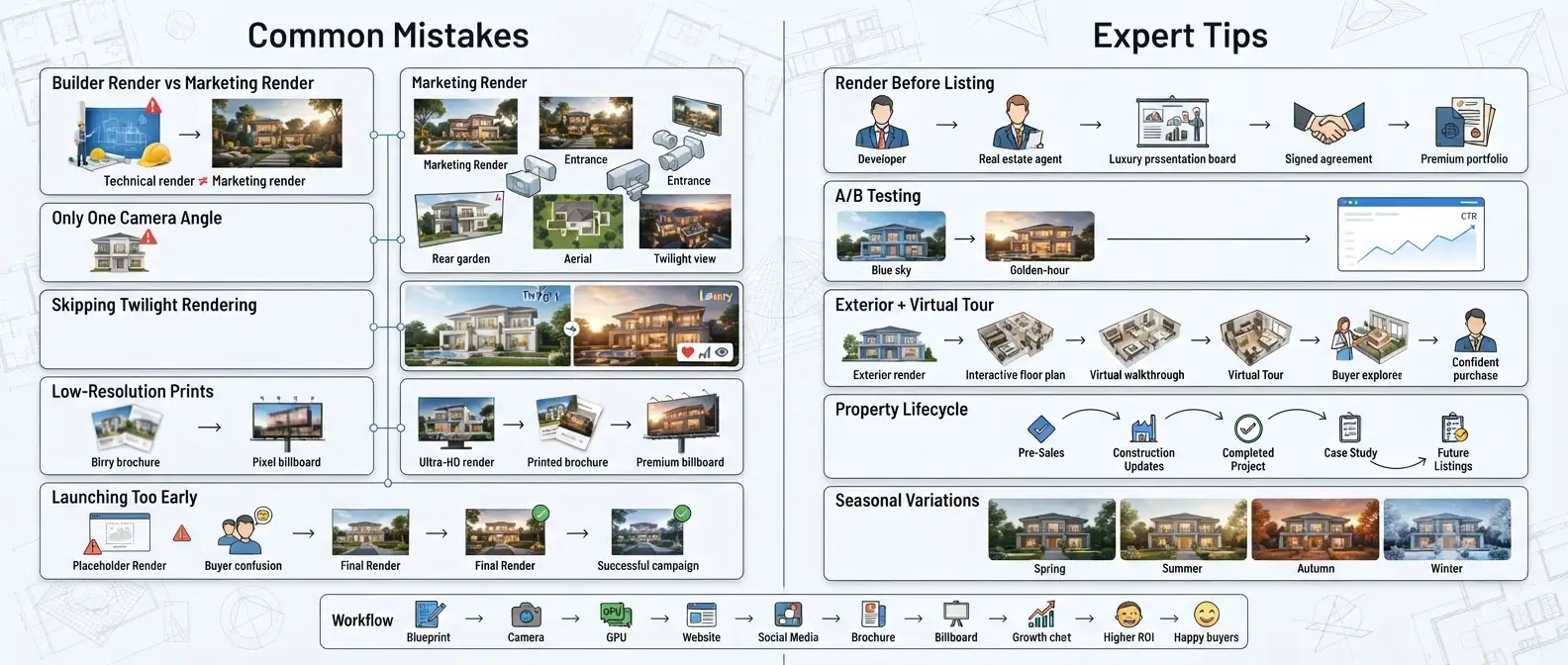
Using Renders From the Builder Without Marketing-Specific Briefing
Builders and developers commission renderings for planning and design approval purposes. These renderings prioritize technical accuracy and design representation – not buyer emotional engagement. Agents who use builder-supplied renderings for marketing without requesting a marketing-briefed version often receive images that lack lifestyle staging, optimal camera angles, and the emotional resonance that drives buyer inquiry.
Selecting Only One Camera Angle for All Marketing Placements
A single front-elevation rendering is insufficient for a full marketing campaign. Different channels require different angles: the hero listing image demands the most impactful curb-appeal view, while social media stories perform better with a tall portrait crop from a different angle, and the brochure cover needs a composition with negative space for headline typography. Request a full camera angle package rather than a single image.
Skipping the Dusk or Twilight Render
In real estate marketing, the dusk rendering consistently outperforms daytime images in emotional engagement metrics. Interior lighting glowing warmly against an evening sky triggers an instinctive sense of home, comfort, and aspiration that is uniquely powerful in buyer psychology. Omitting this deliverable from the rendering brief is one of the most common and most commercially costly mistakes agents make.
Using Low-Resolution Rendering Outputs for Print
Rendering files delivered at screen resolution (72-96 DPI) are not suitable for printed brochures, signage, or display advertising. Agents must specify print-resolution outputs (300 DPI minimum at intended print dimensions) in the initial brief – not as an afterthought. Requesting resolution upgrades after delivery often incurs additional studio time and delays the print production schedule.
Launching Marketing Before the Rendering Is Final
Releasing a pre-construction listing with placeholder imagery or preliminary renders and planning to update visuals later creates a fragmented buyer journey. Buyers who see an underwhelming image first and return to find an improved rendering experience a trust discontinuity. Always launch the marketing campaign with the final, approved, professional-quality rendering assets in place.
Expert Tips for Real Estate Agents: Maximizing ROI From 3D Exterior Rendering
Tip 1 – Commission the Rendering Before the Listing Agreement Is Signed
Presenting a developer or private seller with a photorealistic exterior rendering at the listing pitch demonstrates marketing sophistication and investment. It differentiates the agent from competitors relying on standard photography and positions the rendering cost as a value-add service rather than a budget negotiation item.
Tip 2 – Use Rendering Variations for A/B Testing in Digital Campaigns
With two or three rendering variants – for example, a midday blue-sky version and a golden-hour dusk version – agents can A/B test creative performance in Facebook and Google ad campaigns. Data on which image variant drives higher click-through rates informs both the current campaign and future listing marketing strategy.
Tip 3 – Pair Renderings With Virtual Floor Plan Tours
3D exterior renderings combined with virtual interior floor plan walkthroughs create a complete digital property experience that mirrors the physical inspection process. Buyers who complete a virtual exterior-to-interior digital journey before attending an in-person inspection arrive significantly more qualified and emotionally invested.
Tip 4 – Repurpose Rendering Assets Across the Full Property Lifecycle
The rendering assets produced for a pre-construction listing continue to generate value throughout the project lifecycle:
- Pre-sales: Primary listing and advertising imagery
- During construction: Progress update communications to contracted buyers
- At completion: Comparison imagery for project case studies and portfolio
- Post-sale: Developer and agent marketing portfolio materials for future campaigns
Tip 5 – Request a Rendering With a Seasonal Variation
For properties in regions with distinct seasonal character, a summer-green landscaping render and an autumn-toned version give the listing extended marketing flexibility across a longer campaign period and allow agents to refresh listing imagery without commissioning entirely new renders.
Research compiled by Zillow’s consumer research division consistently shows that listing quality – measured by image count and visual appeal – is the single strongest predictor of listing engagement metrics including saves, shares, and inquiry form completions on digital property platforms.
How 3D Exterior Rendering Supports New Home Builder and Developer Marketing
Beyond individual listings, 3D exterior rendering for real estate marketing delivers structural commercial value to homebuilders and residential developers operating at scale:
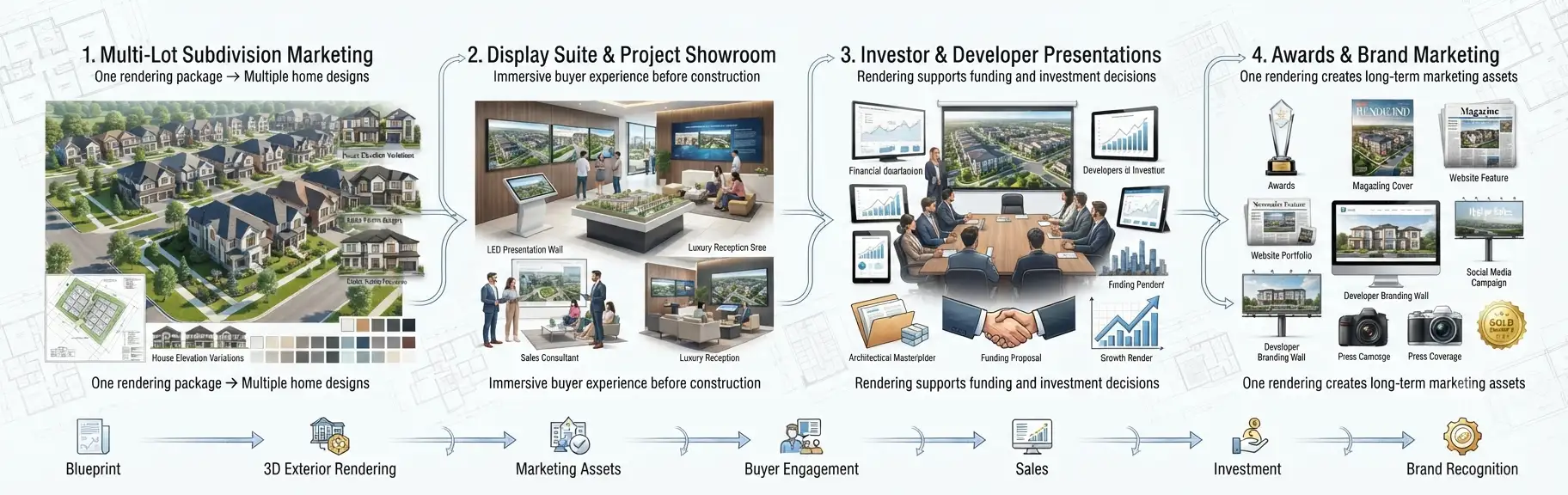
Multi-lot subdivision marketing: A single rendering studio brief covering all facade variants across a subdivision – multiple elevation styles, color schemes, and material options – produces a complete visual catalogue that supports individual lot sales, display village presentations, and project website galleries simultaneously.
Display suite and project showroom content: Large-format printed renders, animated rendering loops, and interactive touchscreen experiences in display suites replace the need for physical show homes in certain project contexts, particularly at the early sales release stage.
Investor and financier presentations: Photorealistic exterior and aerial renderings of proposed developments are standard components of development funding presentations, equity raising documents, and institutional lender submissions.
Award and media submissions: Quality rendering assets support submissions to industry award programs and architectural publications – generating earned media coverage and brand authority for the developer that extends well beyond the individual project.
Frequently Asked Questions (FAQ)
What is 3D exterior rendering for real estate marketing?
3D exterior rendering for real estate marketing is the process of creating photorealistic computer-generated imagery of a home’s exterior – based on approved architectural drawings – for use in property listings, digital advertising, printed brochures, and buyer presentations before the home is physically constructed. It allows real estate agents and developers to launch marketing campaigns, generate buyer inquiries, and execute off-plan contracts from visual assets alone.
Can real estate agents list pre-construction homes using 3D renderings on the MLS?
Yes. Most MLS platforms and major property portals including Zillow, Realtor.com, and Redfin accept photorealistic rendering imagery for pre-construction listings. Agents should clearly disclose in the listing description that images are architectural renderings of the proposed completed home. This transparency maintains buyer trust while allowing the full commercial benefit of professional visual marketing to be realized from day one.
How long does it take to produce a 3D exterior rendering for a real estate listing?
For a standard single-family residential property with complete architectural drawings and a clear marketing brief, professional rendering studios typically deliver initial images within 3 to 7 business days. Revision rounds add approximately 1 to 3 business days each. Animated walkthrough deliverables and interactive 360-degree panoramas require longer production timelines, typically 2 to 3 weeks.
What source documents does a rendering studio need from a real estate agent?
The rendering studio requires: all four building elevation drawings, a site plan showing the home’s orientation and lot context, a material and finish specification schedule, a landscape plan or planting brief, and any HOA-approved color palette documentation. The more complete and finalized the source documents, the more accurate and commercially credible the final rendering output.
Is 3D exterior rendering cost-effective for individual real estate agents?
Yes – when evaluated against the commercial upside of a property sale. The rendering cost for a standard residential property represents a small fraction of the agent’s commission on a typical transaction. Moreover, professional rendering assets generate higher inquiry volumes, shorter time-to-contract, and stronger off-plan buyer confidence – each of which directly improves the agent’s commercial outcome on the listing.
How does a dusk rendering differ from a standard daytime render and why does it matter?
A dusk or twilight rendering shows the home at the end of the day with interior lights glowing, exterior pathway and landscape lighting activated, and a sky rendered in warm peach-to-lavender gradient tones. The emotional impact of this lighting scenario is significantly stronger than a standard daytime image because it triggers associations with warmth, comfort, and home arrival – the core emotional drivers in residential buyer psychology. In digital advertising, dusk renders consistently outperform daytime images in click-through rate metrics.
Can the same rendering assets be used for both online and print marketing?
Yes, provided the studio delivers print-resolution files (300 DPI minimum at intended print dimensions) alongside standard screen-resolution versions. Agents should specify all intended output formats – MLS digital, social media ads, brochure print, signage, and display suite prints – in the initial rendering brief to ensure all deliverables are produced at the correct technical specifications in a single production pass.
Market the Home Before the Foundation is Poured
The pre-construction phase should not be a marketing pause. With 3D exterior rendering for real estate marketing, every day between drawing approval and construction completion becomes an active sales opportunity – complete with professional listing imagery, live digital advertising campaigns, buyer presentation materials, and off-plan contract conversations.
Agents who wait for construction photography to begin marketing lose weeks or months of buyer exposure that competitors with rendering-supported listings are actively converting into signed contracts. The visual gap between a rendered listing and a vacant lot photo is also a commercial gap: in buyer perception, in inquiry volume, in offer quality, and ultimately in sale price and timeline.
The technology is available, the production timelines are fast, and the commercial return is measurable. If you are marketing a new construction or pre-build residential property and want to launch with the visual credibility your listing deserves from day one, partner with a professional rendering team that delivers photorealistic, marketing-ready exterior visualization built specifically for real estate success.
For a comprehensive understanding of the visualization process that powers these marketing assets, explore the full resource on what 3D exterior house rendering is and how it is produced.