
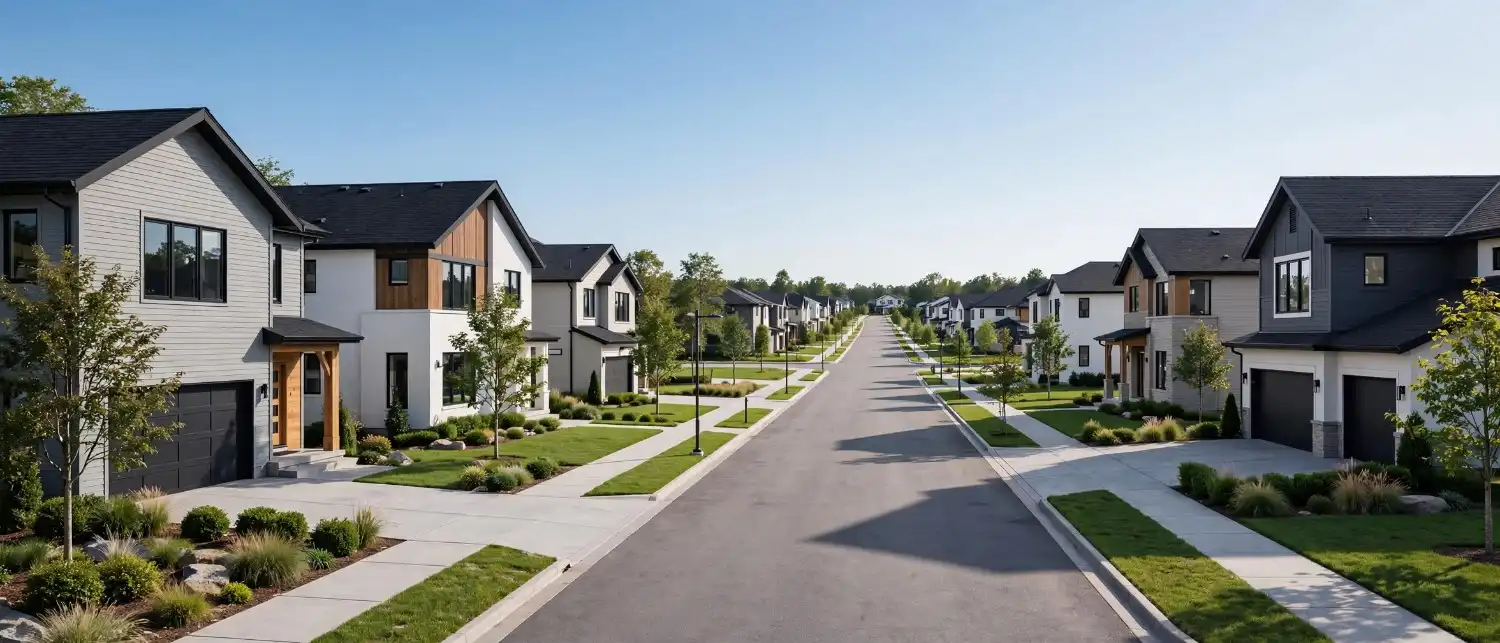
Modern farmhouse exterior rendering combines board-and-batten siding, black-framed windows, and steep gable rooflines into a single photorealistic visualization that lets builders and homeowners preview the finished home before a single foundation is poured. The style blends rustic material warmth with clean architectural lines, and studios rely on physically-based rendering (PBR) materials, HDRI lighting, and layered landscape staging to reproduce that contrast convincingly. Getting the look right on screen requires the same material accuracy, proportion discipline, and lighting logic that defines the style on a real job site.
Farmhouse design has moved a long way from the weathered barns and porch swings that originally defined it, and the rendering industry has had to move just as fast to keep pace. Studios that specialize in 3D exterior house rendering are now expected to reproduce texture-level detail on siding, glare-accurate black window frames, and landscape context that sells the lifestyle as much as the structure. This guide breaks down the specific design elements that make a rendering read as “modern farmhouse” rather than generic suburban, and it walks through exactly how professional studios capture each one in a 3D scene.
Whether you’re an architect briefing a visualization partner, a builder marketing a pre-construction listing, or a homeowner trying to understand what you’re paying for, this article gives you a practical, technically grounded reference.
What is Modern Farmhouse Exterior Rendering?
Modern farmhouse exterior rendering is a specialized branch of architectural visualization that reproduces the modern farmhouse style, a hybrid aesthetic of rustic materials and minimalist form, as a photorealistic 3D image or animation prior to construction. It answers three questions at once: what will the home look like, how will the materials interact with real daylight, and how will the structure sit within its landscape.
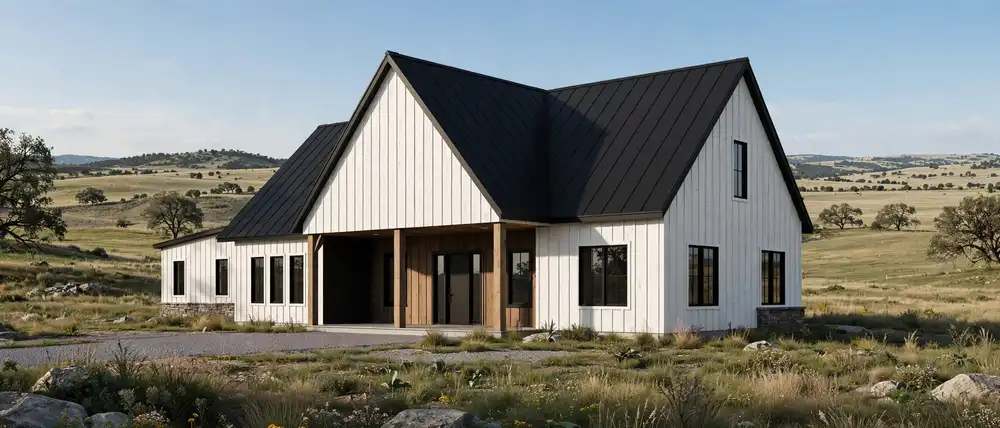
Unlike a generic house rendering, a modern farmhouse exterior rendering has to nail a specific visual vocabulary:
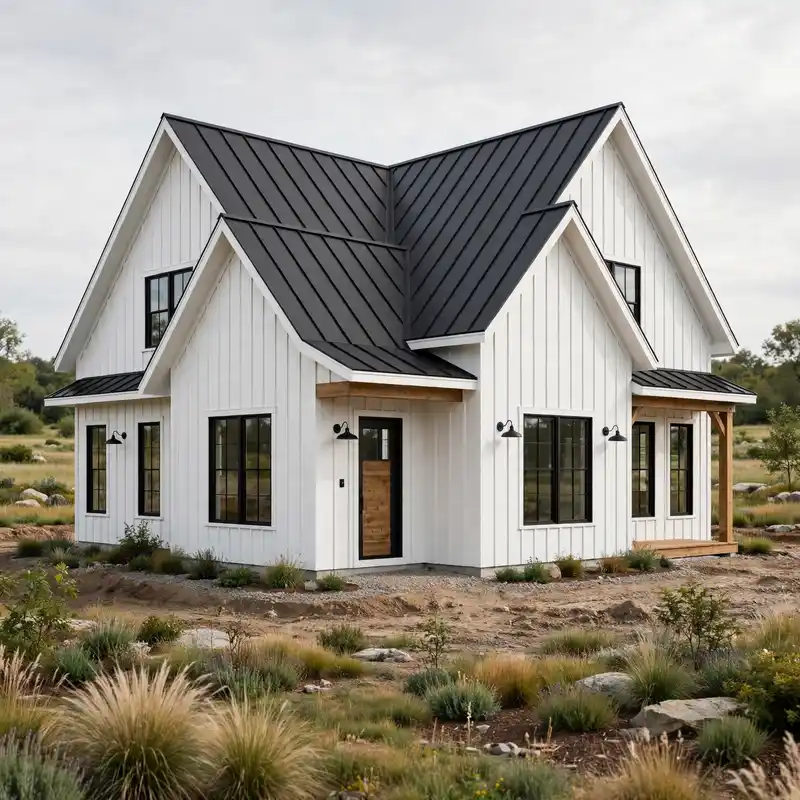
- Crisp, high-contrast siding (typically white or off-white board-and-batten)
- Matte black window frames and hardware
- Steep, simple gable or dual-pitch rooflines
- Natural wood or stone accents used sparingly, not everywhere
- Deep, shaded porches with black or natural-wood posts
- A restrained, mostly monochrome color palette
When any of these elements are rendered inaccurately, such as siding that looks flat and plastic or windows that read as dark gray instead of true matte black, the entire image loses credibility, even if the geometry is correct.
Core Design Elements That Define the Modern Farmhouse Look
Before a rendering studio touches software, it needs a clear list of the architectural signatures that separate modern farmhouse from every other residential style. Below are the elements that show up most consistently across the style, and why each one matters to the rendering process.
1. Board-and-Batten and Horizontal Lap Siding
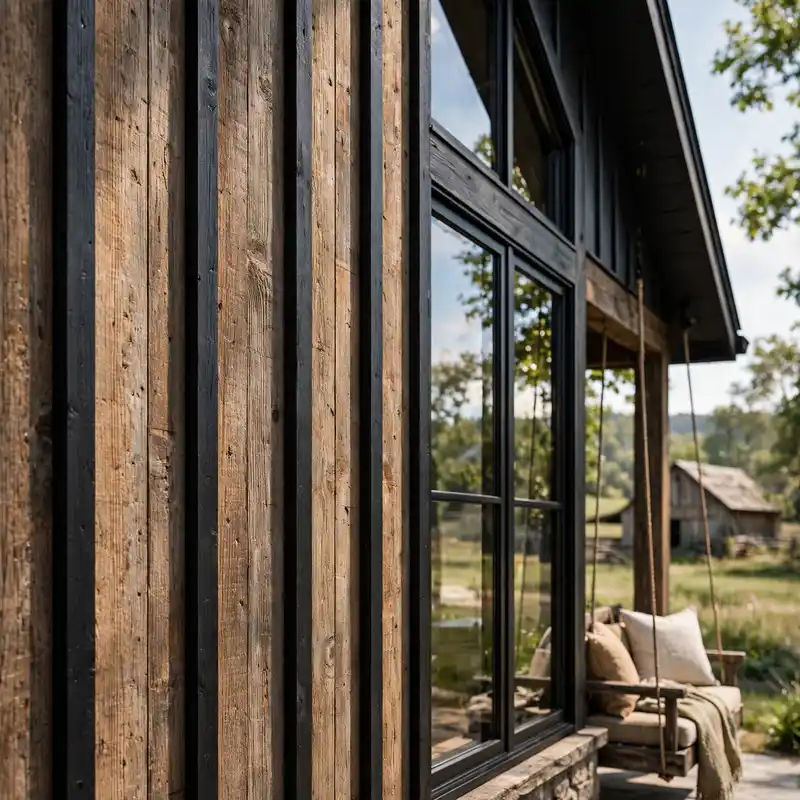
The siding is arguably the single most identity-defining element of modern farmhouse exteriors. Most designs mix two textures: vertical board-and-batten on gables or accent walls, and horizontal lap siding across the main volume. In rendering terms, this means two separate PBR material sets with different normal maps, different panel widths, and slightly different paint sheens, since real siding batches rarely match perfectly.
2. Matte Black Window and Door Frames
Black-framed windows are practically a signature of the style at this point. They create the visual contrast that keeps an all-white facade from reading as flat. Studios need to model true mullion depth, not a flat black decal, so the frames catch shadow correctly at different times of day.
3. Steep Gable Rooflines with Simple Massing
Modern farmhouse rooflines tend to be steep, symmetrical gables or a mix of gable-and-shed forms, often finished in matte black or dark charcoal standing-seam metal. The roof pitch itself is a proportion decision that has to be locked before texturing begins, since even a five-degree pitch error changes the entire silhouette of the home.
4. Wraparound or Deep Front Porches
Porches on this style are functional design elements, not decoration. They’re usually deep enough for furniture, supported by simple black metal or squared wood posts, and shaded enough to create a strong light-to-dark transition against the bright siding. That transition is one of the hardest lighting effects to get right in a render.
5. Mixed Material Facades
Stone or brick accents on a lower third of the facade, a chimney, or a garage volume are common. The key rendering challenge is scale: stone coursing has to be modeled or textured at real-world dimensions, or it reads as a printed pattern instead of a physical material.
6. Restrained, Mostly Monochrome Palette
Modern farmhouse exteriors typically stay within white, off-white, warm gray, black, and natural wood tones. Color grading in the render has to protect that restraint; oversaturating the wood tones or warming the whites too much shifts the image toward a completely different aesthetic.
7. Metal Roofing and Gutter Accents
Standing-seam metal roofing, often in matte black or dark bronze, is now standard on higher-end modern farmhouse builds. It reflects light very differently from asphalt shingle, so it needs its own anisotropic reflection setup in the render engine rather than a generic shingle shader.
8. Landscape and Hardscape Context
Gravel or paver driveways, simple native-plant landscaping, black metal fencing, and minimalist exterior lighting fixtures round out the composition. Studios that skip landscape detailing tend to produce technically correct but emotionally flat renderings.

How 3D Rendering Studios Capture These Elements
Identifying the design elements is the easy part. Reproducing them convincingly in a 3D scene is where studio experience actually shows. Here’s how the process typically breaks down.
Material and Texture Mapping
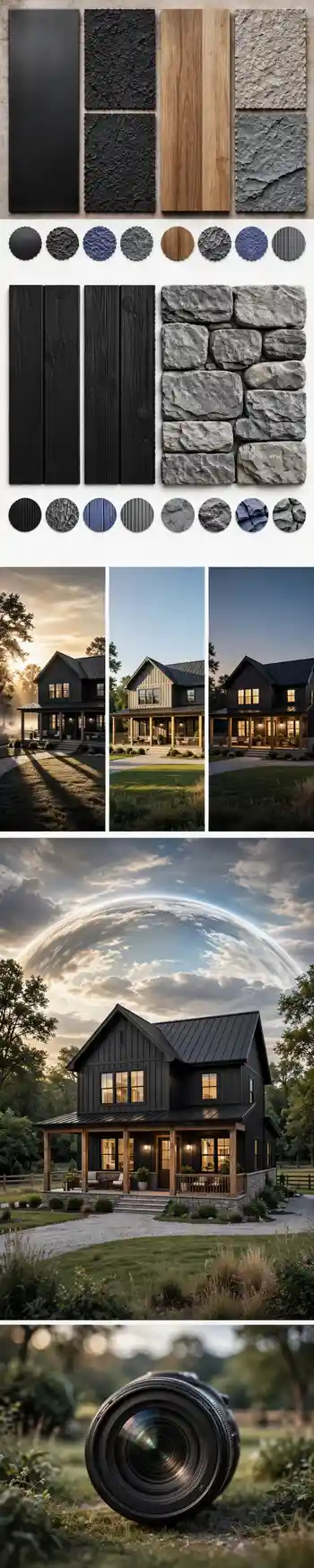
Studios build or source PBR (physically-based rendering) material libraries specific to farmhouse siding, matte black metal, natural wood, and stone. Each material carries multiple maps, including albedo (base color), roughness, normal, and sometimes displacement, so the surface reacts to light the way the real material would. A related deep-dive on this process is available in VHAGE’s guide to how texture mapping shapes realism in exterior visualization, which covers the technical side of building accurate surface materials.
Lighting and Time-of-Day Studies
Because the black-and-white contrast is central to the style, lighting direction and time of day dramatically change how a modern farmhouse rendering reads. Studios typically render:
- A golden-hour version (warm, low-angle light) for marketing hero shots
- A midday version for neutral, accurate color representation
- A dusk version with interior lights glowing through windows, for lifestyle marketing
HDRI (High Dynamic Range Imaging) environment maps are used to simulate realistic sky and ambient light, which is what makes shadows under a porch roof look physically correct rather than artificially dark.
Landscape and Context Staging
Vegetation, driveway materials, fencing, and even the color of the sky are chosen to complement the farmhouse palette rather than compete with it. Overly saturated green lawns or brightly colored flowers can pull attention away from the architecture itself, so experienced studios keep the landscape palette intentionally muted.
Camera Composition and Lens Simulation
Real estate and marketing renderings usually simulate a specific focal length (commonly 24-35mm equivalent) to mimic how a professional architectural photographer would frame the home. A three-quarter angle that shows both the front facade and one side elevation is the most common hero shot for this style, since it captures the roofline, porch, and material transitions in one frame.
Step-by-Step: How Studios Produce a Modern Farmhouse Exterior Rendering
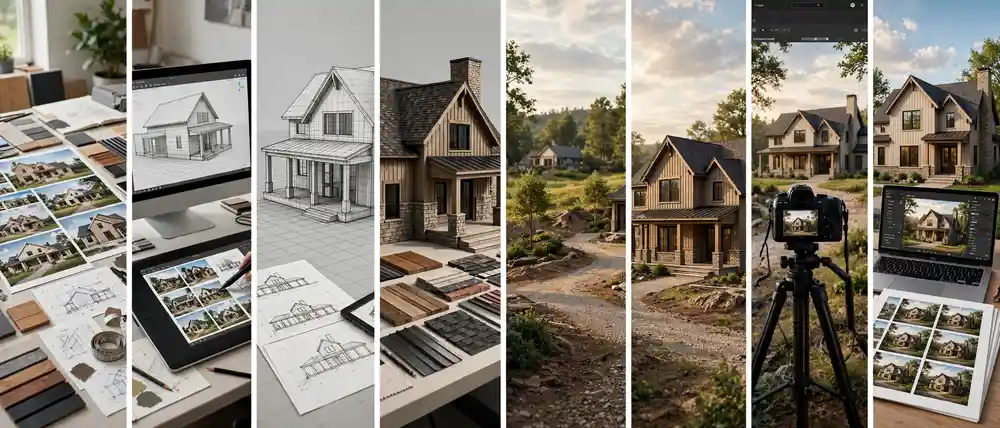
For readers who want the practical production sequence, here’s how most professional studios structure the workflow from brief to final delivery.
- Intake and reference gathering. The studio collects architectural drawings, elevations, and reference photos of similar modern farmhouse builds to align on material and proportion expectations.
- Base geometry modeling. The home’s structural form, roofline, window placements, and porch geometry are modeled to match the architectural plans exactly.
- Material assignment. PBR materials for siding, roofing, trim, and stone or brick accents are applied and calibrated against reference swatches.
- Environment and landscape setup. Terrain, driveway, plantings, and neighboring context (if relevant) are added around the model.
- Lighting setup. HDRI environment and supplemental lighting are configured for the chosen time of day.
- Camera framing. One or more hero angles are selected and locked, typically a three-quarter front view plus a straight-on elevation.
- Render pass and post-production. The raw render is processed, and color grading, contrast adjustments, and minor retouching (sky replacement, foliage cleanup) are applied.
- Client review and revisions. Most studios include one to two rounds of revisions before final delivery in high-resolution JPG, PNG, or print-ready TIFF formats.
Readers who want a broader look at how this fits into the general exterior rendering category can review VHAGE’s overview of what exterior house rendering actually involves from intake to delivery.
Modern Farmhouse vs Traditional Farmhouse Exterior Rendering
The two styles are often confused, but they call for genuinely different rendering approaches. The table below breaks down the key differences a studio needs to account for.
| Element | Modern Farmhouse Rendering | Traditional Farmhouse Rendering |
|---|---|---|
| Siding | Crisp white board-and-batten, sharp panel lines | Weathered lap siding, softer edges |
| Window Frames | Matte black, thin profile | White or natural wood, thicker profile |
| Roofline | Steep, simple gables, metal roofing | Varied pitch, asphalt shingle common |
| Color Palette | Monochrome: white, black, warm gray | Earthier tones: cream, brown, muted red |
| Porch Style | Minimalist black posts, open sightlines | Turned wood posts, railings, more ornamentation |
| Lighting Mood | High-contrast, crisp shadows | Softer, warmer, less contrast |
| Landscape Staging | Restrained, gravel and native plants | Lush, cottage-garden style planting |
Common Mistakes When Briefing or Producing Modern Farmhouse Exterior Renderings
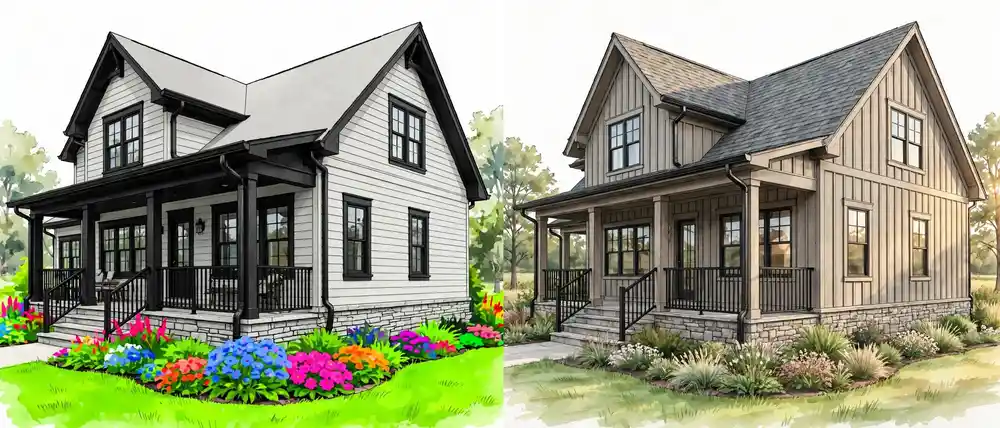
Even experienced teams run into recurring issues with this style. Watching for these upfront saves revision rounds later.
- Overusing black. Applying matte black to gutters, downspouts, railings, and trim all at once can overwhelm the composition. Restraint keeps the contrast intentional rather than heavy.
- Flat-looking siding. Skipping normal and roughness maps on board-and-batten siding produces a painted-cardboard look instead of physical texture.
- Wrong roof pitch. Briefs that don’t specify roof pitch clearly often result in a roofline that looks generic rather than the sharp, steep silhouette the style depends on.
- Oversaturated landscaping. Bright green grass and vivid flowers pull visual weight away from the architecture and clash with the muted material palette.
- Inconsistent lighting direction between shots. When a project needs multiple angles, inconsistent sun position between renders breaks the illusion that they’re the same building at the same moment.
- Ignoring scale on stone or brick accents. Stretching a stone texture without matching real coursing dimensions makes the material look printed rather than built.
Expert Tips for Photorealistic Modern Farmhouse Renderings
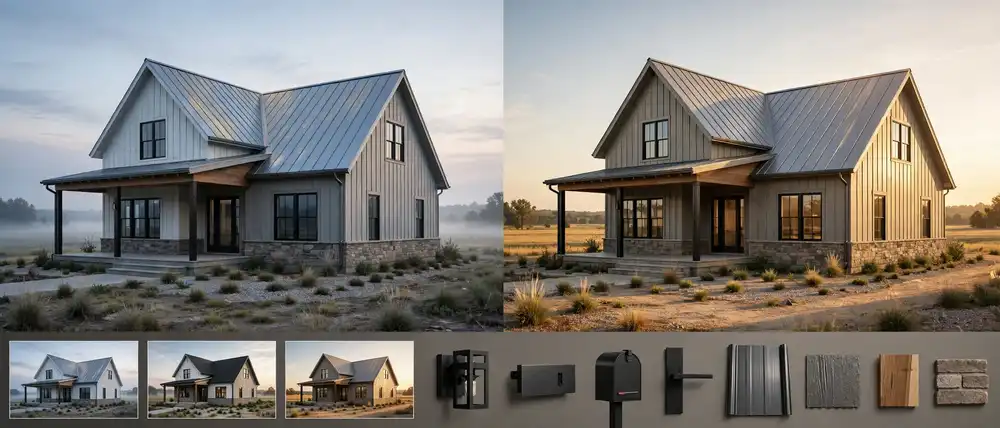
- Reference at least three to five real completed modern farmhouse builds before starting material work; the style has enough subtle variation that generic “farmhouse” material libraries often miss the mark.
- Use anisotropic reflection settings on standing-seam metal roofing rather than a standard glossy shader, since real metal roofing reflects light in linear streaks, not uniform highlights.
- Render the same camera angle at two different times of day early in the process to confirm the lighting setup holds up before committing to final passes.
- Keep landscaping intentionally sparse in early drafts; it’s easier to add greenery than to walk back an overly busy scene.
- Build a callback library of matte black hardware assets (light fixtures, house numbers, mailboxes) since these small details are disproportionately noticeable in this style.
Key Design Elements and Rendering Techniques at a Glance
| Design Element | Real-World Material | Rendering Technique |
|---|---|---|
| Board-and-batten siding | Fiber cement or wood panels | PBR material with normal + roughness maps |
| Black window frames | Aluminum or vinyl-clad frames | True 3D mullion geometry, matte black shader |
| Gable roofline | Standing-seam metal | Anisotropic reflection shader |
| Porch structure | Wood or black metal posts | Ambient occlusion for shadow depth |
| Stone/brick accents | Natural or manufactured stone | Real-scale texture tiling with displacement |
| Landscape | Native plants, gravel, mulch | Scatter systems for foliage, muted color grading |
Who Uses Modern Farmhouse Exterior Renderings
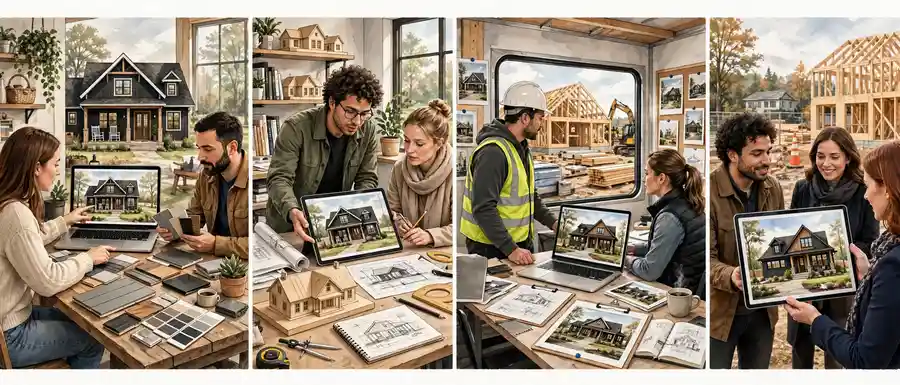
This particular style shows up across several buyer and professional audiences, each using the renderings for a different purpose:
- Homeowners use renderings to confirm material and color decisions before construction begins, avoiding costly changes mid-build. VHAGE covers this use case in detail in its article on how homeowners rely on exterior renderings before breaking ground.
- Architects use them to present design concepts clearly to clients who may struggle to read 2D elevations, a workflow explored further in how architects present designs through exterior rendering.
- Home builders and developers use modern farmhouse renderings in pre-construction marketing campaigns, since the style photographs well on listing sites and social media.
- Real estate agents use them to market spec homes before the framing is even finished, generating early buyer interest.
If you’re evaluating vendors for this kind of project, it’s worth understanding what separates a strong rendering partner from an average one before committing to a studio.
According to industry housing trend data, the National Association of Home Builders has tracked continued buyer preference for farmhouse-adjacent exterior styles in new single-family construction, reinforcing why studios keep investing in style-specific rendering accuracy. Broader design coverage from outlets like Architectural Digest also tracks how the modern farmhouse aesthetic continues to evolve in real built projects, which studios use as ongoing visual reference.
Frequently Asked Questions
What makes a rendering look “modern farmhouse” instead of just a generic white house?
The combination of matte black window frames, board-and-batten siding, a steep simple gable roofline, and a restrained monochrome palette together is what reads as modern farmhouse. Any one of these elements alone isn’t enough; it’s the combination and proportion that sells the style.
How long does a modern farmhouse exterior rendering typically take to produce?
Most single hero-angle renderings take between three and seven business days, depending on revision rounds and whether multiple lighting scenarios or camera angles are required.
Can a modern farmhouse exterior rendering be produced from architectural drawings alone?
Yes. Studios regularly work directly from 2D elevations, floor plans, and material specification sheets without needing a physical site visit, though reference photos of the actual lot help with landscape and context accuracy.
What file formats are modern farmhouse exterior renderings usually delivered in?
Standard delivery includes high-resolution JPG or PNG files for digital and marketing use, with print-ready TIFF files available on request for large-format displays or brochures.
How many revision rounds are typically included?
Most studios include one to two rounds of revisions in a standard project scope, covering material adjustments, lighting changes, and minor landscape edits.
Is modern farmhouse exterior rendering more expensive than other residential styles?
Not inherently. Pricing is driven more by scene complexity, number of camera angles, and revision rounds than by architectural style itself, though the layered material work in this style can add modest time compared to simpler facades.
Conclusion
Modern farmhouse exterior rendering succeeds or fails on detail: the exact matte finish of a black window frame, the panel width of board-and-batten siding, the pitch of a gable roofline. Studios that understand the style’s specific visual vocabulary, and that build their material libraries and lighting workflows around it, produce renderings that do real marketing and decision-making work rather than generic house illustrations. Request a modern farmhouse exterior rendering quote from VHAGE to see how these techniques apply to your next project.